Transitioning your classroom from Khan Academy to CodeGuppy
Khan Academy's computer programming section has been a popular choice for introducing students to JavaScript and creative coding. Built on the ProcessingJS library, it provides a familiar canvas-based environment where students draw shapes, create animations, and build simple interactive programs.
If you've been teaching with Khan Academy and are looking for a platform that takes students further, codeguppy.com is worth serious consideration. Both platforms share the same Processing heritage, which makes the transition remarkably smooth.
Why consider the switch?
Khan Academy uses an older library
Khan Academy's coding platform is built on ProcessingJS, which is no longer actively maintained. codeguppy.com, on the other hand, is built on p5.js — the modern successor to ProcessingJS. Learning p5.js gives students skills that are current and widely supported.
A bigger canvas and more room for growth
Khan Academy's coding environment is limited to a 400x400 pixel canvas — fine for basic exercises, but restrictive for ambitious projects. codeguppy.com provides an 800x600 canvas, giving students three times more space to build detailed scenes, complex game worlds, and visually engaging programs. Beyond the larger canvas, codeguppy.com is designed for building complete projects. Students can create multi-scene games, use built-in sprite libraries, and work with a richer set of tools.
Built-in assets for game development
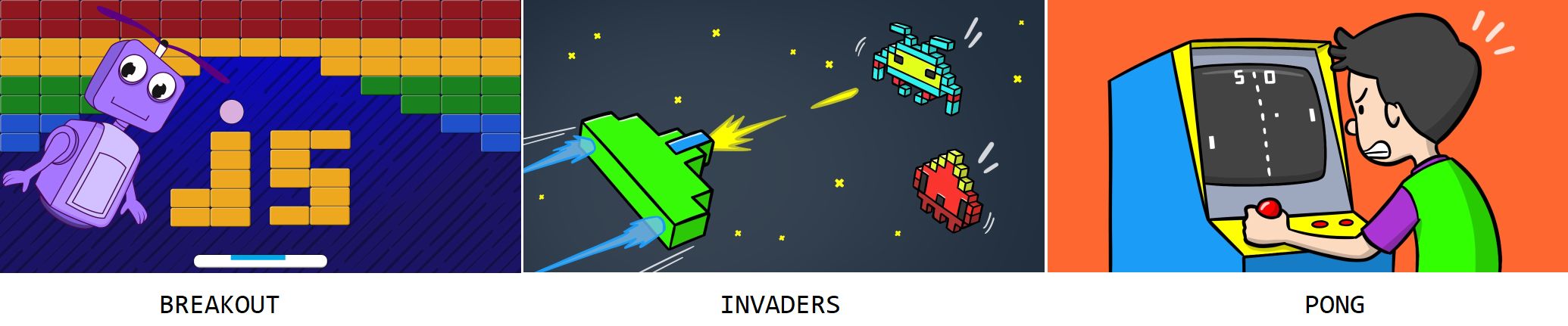
One of the biggest motivators for students is game development. codeguppy.com comes with built-in characters, backgrounds, and tiles that students can use immediately. This removes a major barrier and lets students focus on code rather than art assets.
A project-based approach
codeguppy.com includes dozens of example projects that students can explore, modify, and remix. This project-based approach helps students learn by doing, which is often more effective than tutorial-style exercises.
What stays the same
The good news is that most of the core concepts transfer directly:
- Drawing functions:
rect(),ellipse(),line(),triangle(),fill(),stroke(),background()— all work the same way. - The animation loop: Both platforms use a function that runs continuously to create animations. Khan Academy uses
draw(), and codeguppy.com usesloop(). - Variables, loops, and conditionals: All standard JavaScript concepts carry over completely.
- Mouse and keyboard input:
mouseX,mouseY,mouseIsPressed, andkeyIsPressedare available on both platforms. - The coordinate system: Both use a canvas with (0,0) at the top-left corner.
Key differences to be aware of
| Khan Academy | codeguppy.com |
|---|---|
| ProcessingJS (older) | p5.js (modern, actively maintained) |
| 400x400 pixel canvas | 800x600 pixel canvas (3x more space) |
color(r, g, b) for colors |
Direct fill(r, g, b) or CSS color strings |
| Limited sprite support | Full sprite library with sprite() |
| Single program per project | Multi-scene support |
| No built-in game assets | Built-in sprites and backgrounds |
Tips for a smooth classroom transition
-
Start with familiar territory. Have students recreate a simple Khan Academy drawing project on codeguppy.com. They'll see how similar the code is.
-
Introduce sprites early. Students who come from Khan Academy may not have used sprites. Show them
sprite()and let them experiment with the built-in character library. -
Use example projects. codeguppy.com's built-in projects are excellent conversation starters. Let students browse, pick one that interests them, and study the code.
-
Encourage remixing. Just like Khan Academy's spin-off feature, codeguppy.com encourages students to take existing projects and make them their own.
Conclusion
Transitioning from Khan Academy to codeguppy.com doesn't mean starting over. It means building on the foundation your students already have while giving them access to a more powerful, modern platform. The core concepts remain the same, the syntax is nearly identical, and the creative possibilities expand significantly.
Visit codeguppy.com to explore the platform and see how easily your existing curriculum can adapt.
Read more blog articles Browse JavaScript projectsAbout codeguppy
CodeGuppy is a FREE coding platform for schools and independent learners. If you don't have yet an account with codeguppy.com, you can start by visiting the registration page and sign-up for a free account. Registered users can access tons of fun projects!
Follow @codeguppy on Twitter for coding tips and news about codeguppy platform. For more information, please feel free to contact us.