How much did a megabyte of storage cost in 1980?
Today, you can buy a USB flash drive with 128 gigabytes of storage for about $10. That's enough to hold tens of thousands of photos, thousands of songs, or hundreds of movies. But storage wasn't always this cheap. In fact, the cost of storing data has dropped so dramatically over the decades that it's one of the most extreme price decreases in the history of technology.
How much did storage cost through the years?
Let's look at the approximate cost of storing one megabyte (enough for about one high-quality photo) over the decades:
| Year | Cost per megabyte | What you'd get for $100 |
|---|---|---|
| 1956 | $85,000 | 0.001 MB (about 1 kilobyte) |
| 1965 | $21,000 | 0.005 MB |
| 1975 | $500 | 0.2 MB |
| 1980 | $230 | 0.4 MB |
| 1985 | $75 | 1.3 MB |
| 1990 | $8 | 12 MB |
| 1995 | $0.90 | 111 MB |
| 2000 | $0.01 | 10 GB |
| 2010 | $0.0001 | 1 TB |
| 2020 | $0.000015 | 6.5 TB |
| Today | ~$0.00001 | ~10 TB |
That's a drop from $85,000 per megabyte in 1956 to less than a thousandth of a penny per megabyte today. The price has fallen by a factor of roughly 10 billion!
The first hard drive: IBM 350 (1956)
The world's first commercial hard drive was the IBM 350 Disk Storage Unit, part of the IBM 305 RAMAC computer. Let's compare it to a modern USB drive:
| Feature | IBM 350 (1956) | USB drive (today) |
|---|---|---|
| Storage capacity | 5 MB | 128,000 MB (128 GB) |
| Size | Size of two refrigerators | Size of your thumb |
| Weight | About 1 ton | About 10 grams |
| Cost | $35,000/year rental ($85,000/MB) | ~$10 total (~$0.00008/MB) |
| Disks | 50 spinning platters, each 24 inches wide | Solid-state flash memory chip |
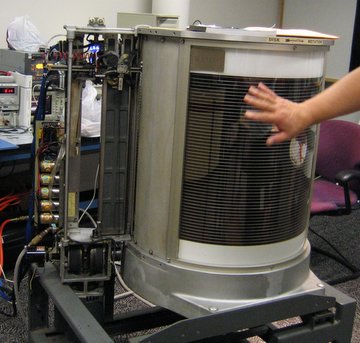
The IBM 350 stored just 5 megabytes — less than a single modern smartphone photo — and it was the size of two large refrigerators. It couldn't be purchased; IBM only rented it for $3,200 per month (about $35,000 per year in today's dollars).
The floppy disk era (1970s–1990s)
In the 1970s, floppy disks made personal data storage portable for the first time. They went through several sizes:
- 8-inch floppy (1971): Stored about 80 KB. It was called "floppy" because the disk was flexible — it actually flopped around when you waved it.
- 5.25-inch floppy (1976): Stored 110 KB to 1.2 MB. This was the standard for early personal computers like the Apple II and IBM PC.
- 3.5-inch floppy (1982): Stored 720 KB to 1.44 MB. Despite the rigid plastic case, the name "floppy" stuck because the disk inside was still flexible.
At their peak in the 1990s, a box of ten 3.5-inch floppy disks (14.4 MB total) cost about $10. That's roughly $0.70 per megabyte — cheap for the time, but about 70,000 times more expensive than storage today.
If you wanted to store the contents of a modern 128 GB USB drive on 3.5-inch floppies, you would need about 89,000 floppy disks. Stacked up, they'd form a tower about 320 meters tall — roughly the height of the Eiffel Tower!
The CD and DVD era (1990s–2000s)
- CD-ROM (1985): Stored 700 MB — about 486 floppy disks' worth.
- DVD (1996): Stored 4.7 GB — about 3,264 floppy disks' worth.
- Blu-ray (2006): Stored 25 GB — about 17,361 floppy disks' worth.
CDs and DVDs dramatically reduced the cost per megabyte and made it practical to store entire software programs, movies, and music collections.
The hard drive revolution
Hard disk drives (HDDs) became affordable for home computers in the 1980s and have been getting cheaper and bigger ever since:
- 1980: A 10 MB hard drive for a personal computer cost about $3,500 ($350/MB)
- 1990: A 40 MB drive cost about $350 ($8.75/MB)
- 2000: A 20 GB drive cost about $200 ($0.01/MB)
- 2010: A 1 TB drive cost about $70 ($0.00007/MB)
- Today: A 4 TB drive costs about $80 ($0.00002/MB)
Solid-state drives and flash memory
The latest revolution in storage is solid-state drives (SSDs) and flash memory — the same technology in USB drives, SD cards, and modern laptops. Unlike hard drives, they have no moving parts (no spinning disks or moving read/write heads), which makes them:
- Much faster (data access in microseconds instead of milliseconds)
- More durable (no mechanical parts to break)
- Silent (no spinning noise)
- More energy-efficient
SSDs were initially very expensive, but prices have plummeted. In 2010, an SSD cost about $3 per gigabyte. Today, they cost about $0.05 per gigabyte — a 60x decrease in just 15 years.
Putting it in perspective
Here are some fun comparisons to help you appreciate how much storage costs have changed:
The music comparison: In 1985, storing one song (about 4 MB) digitally would have cost about $300 in storage alone — and that's before anyone had invented the MP3 format. Today, that same 4 MB costs less than a hundredth of a penny to store.
The photo comparison: Storing one high-quality digital photo (about 5 MB) in 1980 would have cost over $1,000 in storage. Today, the same photo costs a tiny fraction of a cent to store. Your phone can hold tens of thousands of photos.
The movie comparison: A single HD movie (about 4 GB) would have required storage worth about $340,000 in 1980. Today, you can store it for less than a penny.
The total comparison: The amount of storage you get in a $10 USB drive today would have cost approximately $10 billion in 1956 — more than the entire NASA budget that year.
Why did prices drop so dramatically?
Several factors drove this incredible decrease:
-
Miniaturization: Engineers kept finding ways to pack more data into less physical space. Hard drive data density has increased by more than a billion times since the 1950s.
-
Manufacturing improvements: Mass production techniques made it cheaper to produce storage devices.
-
New technologies: Each new storage technology (magnetic tape to hard drives to SSDs to flash memory) brought dramatic improvements.
-
Competition: Many companies competing in the storage market drove prices down.
The bottom line
The cost of storage has fallen by roughly 10 billion times since the first hard drive in 1956. This incredible decline is one of the reasons we live in a digital world — when storing information becomes almost free, it changes everything about how we create, share, and preserve knowledge.
The next time you casually save a file on codeguppy.com or download a photo, remember: the storage for that one file would have cost more than a car just a few decades ago. We live in remarkable times.
Read more blog articles Browse JavaScript projectsAbout codeguppy
CodeGuppy is a FREE coding platform for schools and independent learners. If you don't have yet an account with codeguppy.com, you can start by visiting the registration page and sign-up for a free account. Registered users can access tons of fun projects!
Follow @codeguppy on Twitter for coding tips and news about codeguppy platform. For more information, please feel free to contact us.